At thirty-one, I had gotten good at the kind of smiling that didn’t reach my eyes.
The living room was warm in that overly heated way my mother liked, like she was trying to sweat out anything uncomfortable before it could be said out loud. The Christmas tree glowed in the corner, every ornament placed with the kind of care my family never seemed to have for me. There were twinkling lights, cinnamon-scented candles, and a platter of cookies that looked like they belonged in a magazine. My sister Kay sat cross-legged on the rug, already filming on her phone, angling it just right so she’d look surprised no matter what happened.
“Okay, okay,” Mom said, clapping her hands like we were at a toddler birthday party instead of a holiday gathering for adults. “Morin, you first.”
My name always sounded different coming out of her mouth. It was never soft. It was an announcement. A setup.
I took the small, lumpy package she offered me. Red paper. Green ribbon. A bow that had been re-used so many times it had permanent creases. I shook it once, not because I expected anything good, but because everyone was looking and I needed to perform the role of Grateful Daughter. When I peeled back the paper, I saw the white ceramic mug right away, the kind you’d find in a bargain bin near a register. The lettering was bold and cheerful, like an inspirational quote that got lost on the way to the printer and came back mean.
My fingers tightened around the handle before I could stop them.
My mother cackled, her head thrown back, her laugh too loud for the joke. Dad smirked, like he’d been waiting all week to see if it landed. Kay tilted her head and smiled with the sympathy people reserve for minor car accidents on the side of the road.
“Oh my god,” Kay said, dragging the words out. “That’s so you.”
I heard myself laugh. It came out thin and polite, like it had been taught manners. I held the mug up so Kay’s camera could catch it. I even managed to say, “Thank you,” because what else was I supposed to do? Throw it? Cry? Explain that the joke worked because everyone in this room already agreed I was the least important person in it?
“See?” Mom said, pleased. “You can take a joke.”
I wanted to ask when, exactly, I’d been given a choice.
Instead, I set the mug down carefully on the coffee table and wrapped my hands around my paper cup of coffee, which had gone lukewarm, bitter, and somehow too sweet all at once. I stared at the tree and counted the seconds between my breaths.
Mom clapped again. “Okay, Kay. Open yours.”
Kay’s grin was immediate, like she’d been promised something shiny if she kept the performance going. She grabbed a long box and ripped it open with theatrical urgency. Tissue paper flew. Her phone stayed aimed at her face.
Inside was a key fob attached to a red satin bow.
For a moment, my brain didn’t understand what I was seeing. It tried to translate the object into something smaller, something safer. A new house key. A gym membership. A rental. Anything that didn’t mean what it meant.
Kay gasped and slapped a hand to her mouth. “No way. No way.”
Dad leaned forward, suddenly energetic. “Go on,” he said. “Go look.”
Kay bolted for the front door in her heeled boots, shrieking like she’d won a game show. Mom followed, calling out, “Careful on the steps!” like the only danger in the world was ice.
I stood up slowly, not because I wanted to see, but because I needed proof that I wasn’t imagining it. That I hadn’t somehow missed the moment where my family became fair, or at least consistent.
Outside, the cold hit my face like a slap. Snow glittered under the porch light. And in the driveway, parked like an offering, was a brand new silver car with a red bow the size of a small child draped across the hood.
Kay ran her hands over it like it was alive. “Oh my god,” she whispered. Then louder: “OH MY GOD.”
Mom’s voice turned syrupy. “She needs something reliable for interviews. You understand, honey, right?”
I looked down at my hands, still half expecting to see the mug in them like a punchline I couldn’t put down. “Sure,” I said, because the alternative was screaming until my throat bled.
Dad nodded approvingly at the car as if he’d built it himself. “Investing in the future,” he said.
Kay turned to them, eyes shining. “You guys are the best parents ever.”
I stood a little apart, watching snow collect on my coat sleeve. My paid-off, six-year-old car sat at the curb, the paint chipped on the bumper from a parking lot incident I’d never gotten around to fixing. Every dent on it was mine, earned with overtime and skipped dinners and saying no to things I wanted because I’d learned early that nobody was coming to rescue me.
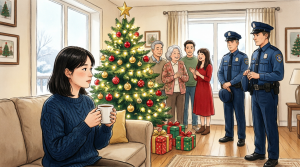
Inside, the living room filled with excited chatter about features and payments and insurance. I sat on the edge of the couch and let my mind drift to the place it always went when I was cornered by the same story: the time Dad forgot my college graduation because Kay had a “rough day,” the years Mom called me “the easy one” like it was a compliment, the way my needs were always categorized as optional.
When it was finally time to leave, I smiled again. I hugged Mom, who smelled like vanilla and victory. I hugged Dad, who patted my back like I was a distant relative. Kay barely looked up from her phone.
“Drive safe,” Mom called. “Text me when you get home.”
I nodded and stepped into the cold.
In my car, the heat kicked on slowly. I sat for a minute with my hands on the steering wheel, breathing in the quiet. Snow tapped softly against the windshield like someone asking to be let in. For a moment, I thought maybe I could let it go. Maybe it was just a stupid mug and a car and the same old imbalance, and maybe I’d keep being the kind of daughter who swallowed her feelings and called it maturity.
Then my phone buzzed.
Fraud alert, my bank app said. A charge of $23,748 at Elite Auto Center.
My stomach dropped so fast it felt like the world tilted.
I stared at the screen until the words stopped being letters and became a sound, the roar of blood in my ears. I didn’t need to look up the dealership name. I’d seen it an hour ago, printed in shiny black on the license plate frame of Kay’s new car.
My thumb moved on its own, opening my banking app. The charge was sitting there, bold and final.
It wasn’t on my primary card. It was on the secondary one.
The emergency card.
The one I’d given my parents three years ago when Dad had surgery and Mom cried in the kitchen about how scary life was and how she just wanted peace of mind. The one I’d handed over with clear rules and a text message I still remembered word for word: medical or house stuff only.
I didn’t cry.
I didn’t scream.
I just felt something inside me go quiet in a way it never had before, like a door finally closing after being left open too long.
I called the bank. I froze the card. I revoked access. I canceled the monthly transfer I’d been sending to help with their mortgage. Six hundred dollars a month, every month, for nearly three years. Money I’d given because I believed family meant showing up, even when it hurt.
When the fraud department asked if I recognized the charge, my voice didn’t shake. “No,” I said. “I didn’t authorize it.”
When I hung up, I looked at the passenger seat where the mug sat in its gift bag, cheerful letters facing up like it was proud of itself.
I peaked in the womb.
I reached over and tipped it into the floorboard.
It didn’t break.
Of course it didn’t.
I drove home through the snow with the bank’s confirmation email open on my phone at red lights, my mind strangely calm. The calm wasn’t peace. It was the calm of finally understanding the rules of a game you never agreed to play.
And as I pulled into my apartment parking lot, I made one more call, not to my mother, not to my father, not to Kay.
To the police department’s non-emergency line.
Because if they wanted to turn me into the family joke, fine.
But I wasn’t going to be the family wallet anymore.
The next morning, I woke up before my alarm, the way you do when your body decides sleep is no longer a safe place.
Outside my window, snow fell in thick, lazy flakes, drifting past the streetlight like it had nowhere better to be. My apartment was quiet, the kind of quiet I used to pay extra for. I sat up and listened anyway, half expecting my phone to explode with calls, my door to rattle with pounding fists, my mother’s voice cutting through the walls.
Nothing.
Then my screen lit up.
Ten missed calls from Mom. Three from Dad. Six from Kay. A handful of texts that were all variations of confusion dressed up as accusation.
Why did you freeze the card?
The dealership called.
What is going on?
You embarrassed us.
Call me now.
Not one message said, I’m sorry.
Not one asked if I was okay.
I swung my legs out of bed and walked to the kitchen. The mug sat on the counter because last night I’d set it there like a warning sign. The words looked even uglier in daylight. I ran water for coffee, watched the dark stream fill the pot, and tried to remember the last time Christmas didn’t make me feel like a guest in my own family.
By the time I’d taken two sips, I knew I needed to see them in person. Not because I thought they’d suddenly be honest, but because I needed to hear what lie they’d chosen. I needed to know what version of reality they believed I was supposed to accept.
Their house looked exactly the same as it always had: beige siding, wreath on the door, crooked reindeer lights blinking like a stutter. The driveway was empty where the silver car had been the night before. Kay must have taken it out early, eager to keep showing it off while she still could.
Mom opened the door in her robe, hair piled up in a messy bun, her face already arranged into the expression she used when she wanted to appear wronged and welcoming at the same time.
“Oh, Morin,” she said, like my presence was both a surprise and an inconvenience. “I didn’t know you were coming.”
“I know you used my credit card,” I said.
No hello. No small talk. No letting her steer the conversation into safer waters. Just truth.
Her eyes widened, then narrowed, then softened in a practiced sequence. “Come inside,” she said quickly. “It’s freezing.”
I stepped past her into the living room. Dad was on the couch with a newspaper he wasn’t reading. He looked up like he’d been waiting for a moment to decide which side he was on.
“Everything okay?” he asked, and it would’ve almost sounded sincere if my banking app wasn’t still open on my phone like evidence.
“You bought Kay a car,” I said. “With my card. Twenty-three thousand, seven hundred forty-eight dollars.”
Dad lowered the paper. The sound of it folding felt louder than it should’ve. Mom moved immediately, positioning herself between us like a referee.
“Well, honey,” she began.
“Don’t,” I said, sharper than I meant to, but the word came out with years attached to it. “Don’t tell me it’s not what it looks like.”
Mom’s lips tightened. “Kay needed something reliable for job interviews.”
I stared at her. I waited for the punchline. For her to say she was kidding. For her to hand me some envelope of cash, some explanation that made sense, some proof that I hadn’t been right about them all along.
Instead, she shrugged. “You know how bad the buses are.”
I laughed, but it wasn’t humor. It was disbelief turning into noise. “So you committed fraud because the bus schedule was inconvenient.”
“It’s not fraud,” Dad said, raising a hand like he was calming an animal. “You gave us access.”
“For emergencies,” I said.
Mom rolled her eyes. “Oh, come on, Morin. You make good money. We didn’t think it would be a big deal.”
The words landed in my chest like a weight I’d carried so long I forgot it wasn’t normal. We didn’t think it would be a big deal. Meaning: we didn’t think you’d do anything about it.
The front door opened and Kay walked in like she owned the air. Iced coffee in one hand, phone in the other, hair styled perfectly like she was about to be photographed. She stopped when she saw me and let out a dramatic sigh.
“What’s going on?” she asked, like she hadn’t been blowing up my phone all morning.
“She’s upset about the car,” Mom said gently, as if I was a child who’d lost a toy.
Kay groaned. “Oh my god, Morin. Really? You’re mad about that?”
“You used my card without permission,” I said. “That’s theft.”
Kay scoffed. “You’re so uptight. You live alone. You have a great job. It’s not like you’re struggling.”
“And that makes it okay to take my money?”
Kay’s eyes flashed. “Honestly, this is why you’re single. You act like money equals love.”
I felt something in me shift. Not break. Harden. A boundary, forming in real time.
I looked at all three of them—Mom, Dad, Kay—and realized they were waiting. Waiting for me to fold. Waiting for the old version of me who would swallow her anger and call it keeping the peace.
“You can either return the car today,” I said evenly, “or pay me back in full.”
Mom’s face went pale. Dad’s jaw tightened.
“Otherwise,” I continued, “I’m filing a police report.”
Mom’s voice rose into outrage immediately. “You would do that to us? Over a car? It’s Christmas.”
“You didn’t even give me a real gift,” I said, and the quiet that followed felt like truth entering a room that had been padded for years. “You gave me a joke. Then you used my money to give her a car.”
Dad opened his mouth like he wanted to argue, but no sound came out.
“I already froze the card,” I said. “The bank’s aware. I canceled the transfers.”
That one hit hardest. Mom made a sound like she’d been physically struck. “You’re punishing us.”
“No,” I said. “I’m choosing myself.”
I turned and walked out before the conversation could turn into a performance. I didn’t slam the door. I didn’t shout. I didn’t cry on their porch.
In my car, my hands shook a little as I started the engine. Not from fear. From adrenaline. From grief. From the strange, disorienting feeling of finally doing what you’ve threatened in your head a thousand times.
When I got home, I sat at my kitchen table and opened my phone. I scrolled back through old messages until I found the one from three years ago, the one I’d sent to Mom when I gave her the emergency card.
The emergency card is for medical or house stuff only. Please don’t use it for anything else.
I took a screenshot.
Then I downloaded the credit card statement with the dealership charge and saved it.
Then I opened my camera roll and found the photo I’d taken the night before—Kay standing in front of the silver car with the red bow, laughing like she’d earned it. I stared at it for a long moment, surprised by how ordinary she looked, like someone who didn’t realize she was holding a match next to gasoline.
I called the police department’s non-emergency line.
A woman transferred me to an officer. He sounded tired, like he’d heard every version of family betrayal and still had to write it down.
I explained everything calmly. I gave names. Dates. Proof. I told him I had documentation that the card was for emergencies only and that I did not authorize the purchase.
“Are you willing to send that?” he asked.
“Yes,” I said.
He gave me a report number and an email address. I sent the screenshots, the statement, the photo, and a short explanation that stuck to facts instead of feelings.
When I hit send, I expected to feel triumphant.
Instead, I felt steady.
Like I’d finally stopped holding up a collapsing roof with my bare hands.
Three days later, the fallout started.
It began with a text from Kay: You’re unbelievable.
Then a video appeared on her social media: her car being towed from the driveway. She didn’t speak. She just filmed the tow truck pulling it away, her face arranged into wounded disbelief, like someone had stolen something that belonged to her.
The caption read: Some people can’t stand to see you move forward.
She tagged me.
I watched it once, then closed the app. I didn’t respond. I didn’t defend myself in the comments. I didn’t play tug-of-war with a narrative she was determined to own.
Later that day, a private message popped up from someone I barely knew—an old friend of Kay’s from high school.
Not surprised, she wrote. She’s always been like this. She just usually picks people who don’t fight back.
I stared at the message longer than I needed to. It wasn’t comfort, exactly. But it was confirmation. Proof that what happened wasn’t a one-time misunderstanding. It was a pattern. One I’d finally stepped out of.
That night, Mom left a voicemail. Her voice shook, but the words were sharp.
“There were police at the door today,” she said. “They said there’s a report against us for fraud. Morin, how could you? You’re tearing this family apart.”
She didn’t say, We used your money. She didn’t say, We’re sorry. She said, You’re tearing this family apart, like the family was fine until I refused to be robbed.
I deleted the voicemail.
Dad texted an hour later: This has gone too far. We need to talk.
I didn’t reply.
For the first time in my life, silence felt like power instead of punishment.
And somewhere in the back of my mind, I knew the next stage was coming. The stage where everyone who benefited from me would try to convince me I was the problem.
I washed my coffee mug—my real one, plain and sturdy—and put it back in the cabinet.
Then I took the joke mug and dropped it into the trash.
I didn’t take the trash out yet.
I wanted it there a while longer, visible, like a reminder that I wasn’t imagining any of it.
Because this time, I wasn’t going to let the story reset.
The first person to accuse me of being cruel wasn’t my mother or my father.
It was my Aunt Diane, in a group text that included half my extended family and a surprising number of people who hadn’t spoken to me in years unless they needed something.
Did you seriously call the police on your own mother?
I stared at the message until the words blurred. It wasn’t the question itself that stung—people always pick the easiest detail to judge. It was how familiar it felt. Like my family had found a way, once again, to turn the spotlight away from what they did and onto how I reacted.
I typed one sentence.
She used my credit card without permission. I reported it.
Then I put my phone facedown and went back to work.
I work in operations for a healthcare company, the kind of job where you’re expected to keep disasters from becoming emergencies. I’m good at it. I’ve built a life around anticipating problems before they explode, around staying calm when other people panic, around making sure the system doesn’t fall apart because someone else wanted to cut corners.
Sometimes I wonder if I chose the work, or if it chose me.
That week, I walked through my days like everything was normal. I attended meetings. I answered emails. I joined a video call where someone complained about printer ink like it was a crisis. I nodded. I took notes. I smiled at the right moments.
Underneath, my phone kept lighting up.
Kay posted vague quotes about betrayal and family. Mom emailed me long paragraphs that started with Honey and ended with Love, like affection could erase theft. Dad tried to sound reasonable, which was his favorite disguise We’re hurt, Morin. We don’t understand why you did this. You know we would never intentionally harm you.
They never intentionally harmed me. That was always their story. Harm, to them, was something that happened with screaming and fists and strangers. Harm wasn’t taking money because you assumed your daughter would be too “mature” to protest. Harm wasn’t turning her into the butt of the joke every holiday and then expecting her to thank you for being included.
That Friday, the credit card company reversed the charge. Efficient. Quiet. No apology needed. The dealership pulled the car, the bank returned my money, and the financial part of the mess resolved itself like a clean spreadsheet.
The emotional part didn’t.
I sat on my couch that night with my laptop open and my bank app on the screen, watching the numbers like I was checking for a glitch. Everything was in order. Everything was mine again.
I should’ve felt relieved.
Instead, I felt hollow, like I’d spent my entire life trying to earn something my family didn’t know how to give.
I thought back to childhood in fragments, the way memory does when it’s trying to protect you.
Kay at eight, crying because her dance tights were itchy. Mom spending an hour soothing her, buying new ones, promising ice cream after class.
Me at nine, crying because a boy at school had called me ugly. Mom telling me, distracted, “Don’t be so sensitive,” and then calling me “strong” for not needing comfort.
Dad never came to my middle school play because Kay had a soccer game. When I tried to complain, he’d said, “You understand, right? Kay needs us.”
I always understood.
That was the problem.
By Sunday, my parents’ house went up for sale. I found out through a forwarded listing link from my cousin, who texted: I’m not taking sides but… are you okay?
The listing photos were dim and slightly crooked, taken quickly, like my parents wanted the house to look appealing but couldn’t muster the energy for care. The living room was right there on my screen—the same couch Dad had sat on, the same coffee table where my mug had landed like a punchline.
I clicked through every photo and felt nothing. Not satisfaction. Not guilt. Not joy.
Just the quiet certainty that I wasn’t going back to the way things were.
A week later, Mom texted: Can we talk? Just you and me. Like adults.
It made me laugh, a short sound that startled even me. Like adults. As if adulthood was something you could summon only when you needed money.
I didn’t respond right away.
Instead, I called my friend Jessa, the closest thing I had to family that didn’t come with strings. She answered on the second ring.
“You okay?” she asked immediately.
That was always her first question. Not “What happened?” Not “What did you do?” Just: Are you okay?
I surprised myself by saying, “No.”
Then I told her the story, the whole thing, from the mug to the car to the charge to the tow truck. She listened without interrupting, the way people do when they’re actually trying to understand instead of waiting for a turn to speak.
When I finished, she exhaled. “That’s… insane.”
“I keep thinking I’m overreacting,” I admitted. “Like maybe I should’ve handled it privately.”
“Morin,” she said gently, “they spent twenty-three thousand dollars on your card without asking.”
“I know.”
“And when you confronted them, they didn’t apologize. They defended it. And they blamed you.”
“I know.”
“So what exactly would ‘handling it privately’ have done?”
I didn’t have an answer. Because the truth was, handling it privately was what I’d done my entire life. Handling it privately meant swallowing my anger so it wouldn’t inconvenience anyone. It meant letting resentment rot quietly inside me while everyone else kept smiling.
“Okay,” Jessa said. “What do you need right now?”
I looked around my apartment. My small, clean space. My paid bills. My fridge full of groceries I’d bought with my own money. My life that was mine, not borrowed.
“I think,” I said slowly, “I need to stop letting them rewrite reality.”
“Good,” she said. “Then don’t let them.”
The next day, I found a therapist.
It felt dramatic, like something characters did in movies, but I was tired of trying to be my own emergency room. In my first session, I sat on a gray couch and stared at a plant in the corner while I explained the mug and the car. The therapist didn’t flinch. She didn’t ask what I did to provoke it. She didn’t tell me to consider my parents’ feelings.
She just said, “That sounds like a painful pattern.”
Pattern. The word made my throat tighten.
Because patterns are harder to excuse than one-time mistakes.
Over the next few weeks, the pattern revealed itself everywhere. I noticed how my mother’s messages were always about her suffering, never mine. I noticed how Kay’s posts framed her as the victim of my jealousy, never the beneficiary of my family’s entitlement. I noticed how Dad tried to sound like a mediator while quietly supporting whatever kept Kay comfortable.
They weren’t confused about what they’d done.
They were confused that I’d stopped accepting it.
Mom kept pushing for a conversation. She offered coffee. Lunch. A walk. She promised she just wanted to “clear the air.”
The therapist asked me, “What do you think she wants?”
I thought of Mom’s hands on my arm outside by the car, her voice sugarcoated: You understand, right?
“She wants me to make it okay,” I said.
“Do you want to make it okay?” the therapist asked.
And for the first time, I considered the question seriously. Not out of guilt. Out of honesty.
“No,” I said. “I want it to be true.”
That month, I started a new routine. I muted Kay on social media. I set my parents’ texts to silent. I stopped checking my phone every time it lit up like a trained response.
When my aunt Diane texted again, I didn’t reply.
When a cousin sent me screenshots of a family chat where they called me heartless, I didn’t argue. I just sent her the same three attachments: the credit card statement, the old text outlining the card’s terms, and the police report confirmation.
No explanation. No defense. Just facts.
The cousin didn’t message again.
And the silence that followed wasn’t the old silence, the kind meant to punish.
This silence felt like space.
Like breathing room.
Still, the meeting request from Mom sat in my inbox like an unopened bill. Eventually, a part of me that still wanted closure—the part that still wished for a different mother—decided to say yes.
I agreed to meet her at a café near my apartment. Neutral ground. Public. No home-field advantage.
The day before we met, I took the joke mug out of the trash and set it on the counter again.
Not because I missed it.
Because I wanted to look at it one more time and remember exactly what I was walking away from.
Then I turned it upside down, like a period at the end of a sentence.
And I went to bed, knowing the next conversation would either crack something open or seal it shut forever.
Mom was already seated when I arrived, hands folded around a paper cup like she’d been waiting in a church pew.
The café smelled like espresso and clean wood, the kind of place where people typed quietly on laptops and didn’t make eye contact. I’d picked it on purpose. My mother loved cozy booths and dim lighting, spaces where she could turn every conversation into a scene. Here, the world stayed bright and indifferent.
She stood as soon as she saw me, her face opening into a smile that looked rehearsed. She leaned forward for a hug.
I didn’t move.
Her arms hesitated midair, then dropped, and she tried to hide the sting by smoothing her hair.
“Hi, honey,” she said.
“Hi,” I answered, and sat across from her.
For a moment, she studied me like she was searching for the daughter who would apologize for upsetting her. When she didn’t find that version, she cleared her throat and glanced down at her cup.
“I’ve had some time to think,” she began.
I nodded once and waited. I didn’t fill the silence for her. That was an old habit I was trying to break—rushing in to make everyone comfortable.
Mom’s lips tightened at the lack of help. Then she launched.
“We were under pressure, Morin. Your father’s been stressed. Kay’s been… lost. We didn’t mean to hurt you.”
Of course they didn’t mean to. They never meant to. Intent was the shield they held up to block consequences.
“You didn’t ask,” I said simply.
Mom’s eyes flashed. “We didn’t think we had to. You’ve always been responsible. You’ve always handled things.”
There it was. The compliment that doubled as a leash.
I kept my voice calm. “Being responsible doesn’t mean you get to take from me.”
Mom looked wounded, like I’d called her a stranger. “You know we love you.”
“I’m not questioning whether you love me,” I said, though part of me wanted to. “I’m questioning how you treat me.”
She shifted in her seat, discomfort breaking through her performance. “You’re making it sound so… harsh.”
“It was harsh,” I said. “You bought my sister a luxury car with my money and gave me a mug that mocked me.”
Mom’s cheeks flushed. “It was a joke.”
“It was a message,” I replied. “And you’ve been sending it for years.”
For the first time, she went quiet. Not the dramatic quiet she used to punish, but an actual pause, like she’d been forced to consider something she didn’t want to see.
Then she leaned forward, voice lowering as if sharing a secret.
“We’re trying to sell the house,” she said. “It’s taking longer than we thought. We’re behind on a few things. If you could just help with the mortgage for a few more months—just until things stabilize.”
My stomach didn’t drop this time.
I’d expected it. Not this exact wording, but this ending. The conversation wasn’t about accountability. It was about access.
I set my hands flat on the table. “No.”
Mom blinked, her smile flickering like a bad lightbulb. “Morin—”
“No,” I repeated, steady. “I’m not paying your mortgage again.”
Her face tightened. “So you’re really going to let your parents lose their home?”
I leaned in slightly. “You used me like a bank,” I said. “Banks have terms. You broke them.”
Mom’s eyes watered, but I’d seen her cry on cue before. Her voice grew soft, trembling.
“We were desperate.”
“No,” I said. “You were entitled. There’s a difference.”
That landed like a dropped plate. Mom sat back, suddenly smaller, not fragile—deflated. The air went out of her in a way that was almost startling.
For a brief moment, I saw her as a person separate from my pain: a woman who’d built a life around control and favoritism because it was easier than fairness. A woman who’d told herself a story so long she believed it. A woman facing the fact that her oldest daughter wasn’t going to keep the family afloat anymore.
“I hope time heals things,” she whispered.
I didn’t argue. I didn’t promise anything. I just stood.
“Tell Dad I’m not coming back to talk about this again,” I said.
Mom looked up sharply. “He’s your father.”
“I know,” I said. “And I’m his daughter. That didn’t stop him.”
I left the café without looking back.
Outside, the air was cold and clear. The world kept moving: cars passing, people walking dogs, someone laughing on the sidewalk. It was both comforting and brutal, how little the universe cared about my family’s drama.
Two days later, my cousin sent me another screenshot—this one from a family group chat I wasn’t in.
It’s disgusting what Morin’s done. Calling the police. It was a misunderstanding and now our parents are scrambling to survive over a mistake.
Misunderstanding. Mistake. Accident.
A luxury car didn’t happen by accident.
I didn’t respond with anger. I didn’t respond at all. I just forwarded the screenshot to my therapist and wrote: They’re rewriting it again.
She replied: And you don’t have to participate.
That week, I did something I’d never done before: I planned a holiday that wasn’t centered around my family.
Jessa invited me to her place for a small New Year’s dinner. Her boyfriend cooked. Two of her friends brought cheap wine and a board game. Nobody asked me to be smaller. Nobody teased me for being “dramatic.” Nobody treated generosity like a currency they could steal.
At one point, Jessa’s friend asked, “So what’s your family like?”
I hesitated. The old instinct was to minimize, to protect the image of people who had never protected me.
Then I said, “Complicated.”
And that was enough. No one pushed. No one demanded details. They just accepted my answer and passed me the bread.
On January second, Kay messaged me directly.
You happy now? she wrote. Hope ruining our lives was worth it.
I stared at the text for a long time. For a moment, my fingers itched to respond with every ounce of anger I’d swallowed for years. To remind her that she’d laughed while they handed her keys. That she’d called me uptight while spending my money. That she’d tagged me in a tow video like a teenager.
Instead, I typed one sentence.
I didn’t ruin your life. I stopped letting you use mine.
Then I blocked her.
My heart raced as if I’d done something dangerous. But when the adrenaline faded, I felt something else: relief. Real, clean relief.
In therapy, I started naming things I’d never named before: scapegoat. Golden child. Emotional neglect. Financial abuse. Words that felt heavy and sharp, but also accurate, like putting the right label on a file you’ve been fumbling for years.
“It makes sense that you feel guilty,” my therapist said one day. “You were trained to feel responsible for their emotions.”
“I don’t want to be responsible anymore,” I admitted.
“You don’t have to be,” she said. “But you will have to grieve what you didn’t get.”
Grief was the part I hadn’t expected.
Not grief for losing them, exactly. Grief for realizing I’d never truly had them in the first place.
One night in late January, I found the joke mug in the back of my cabinet. I don’t remember putting it there. Maybe I couldn’t stand to see it. Maybe I still needed proof of what happened.
I held it for a moment, feeling the cheap ceramic cool against my palm.
Then I walked to the sink, filled it with water, and poured it slowly down the drain.
It was a small, quiet act, but it felt symbolic. Like emptying something that had taken up space in me for too long.
I rinsed the mug, dried it, and set it in a donation box by the door.
Not because I wanted someone else to drink from it.
Because I didn’t want it in my home anymore.
That was the new rule: my home, my life, my boundaries.
And as winter pushed toward spring, I started to understand something that would’ve terrified me before.
They might never admit what they did.
They might never apologize.
But I could still move forward.
Not as their punchline.
As myself.
By February, the story my family told about me had hardened into something polished and public.
In their version, I was the successful daughter who “forgot where she came from.” The ungrateful one. The cold one. The one who cared more about money than family. Kay posted quotes about loyalty. Mom sent emails full of wistful memories and carefully edited pain. Dad stayed quiet, which was its own kind of statement.
Meanwhile, my life did what it always did: it kept going.
At work, we were gearing up for a major systems transition. Long days. Tight deadlines. The kind of pressure that used to make me feel alive because it meant I was needed. I noticed the old instinct rising—overfunctioning, overachieving, proving my worth.
This time, I tried something different.
I left at a reasonable hour. I ate dinner standing at my counter. I went to therapy. I slept.
One afternoon, my manager called me into a meeting and said, “We want to promote you.”
The words should’ve made me ecstatic. Instead, I felt the first flicker of sadness, sharp and unexpected. Because my first thought wasn’t pride.
It was: Who am I going to tell?
Then I realized I could tell people who would actually be happy for me.
I texted Jessa. Her reply came instantly.
YESSSS. I’m buying champagne. We’re celebrating.
No guilt. No comparison. No joke mug.
That weekend, we went out for brunch. We clinked glasses. Jessa made a toast that made me blush. Her friends cheered like my success belonged in the room instead of threatening it.
Later, when I got home, my phone buzzed with an email from Mom.
Subject line: Address Update.
It was short. We’ve moved. Here’s the new address in case things change.
No apology. No accountability. Just a new mailing location, like I was expected to update my records and continue funding their life from a distance.
I didn’t reply.
I didn’t even feel angry. I felt oddly detached, like I’d finally stepped far enough away to see the whole machine.
A week later, a letter arrived in my mailbox in my father’s handwriting. My chest tightened as I opened it, as if paper could still control me.
Inside was a single page.
Morin,
We didn’t raise you to turn on your family. Your mother is devastated. Kay is struggling. People are talking. I don’t know what happened to you, but this isn’t you. Call me.
Dad
I read it twice.
This isn’t you.
As if the version of me they wanted—silent, compliant, endlessly giving—was my real self, and the version setting boundaries was an impostor.
I folded the letter carefully, like it deserved that much respect, and placed it in a folder labeled Taxes and Other Necessary Evils. Not because it belonged there, but because I was done giving emotional weight to their words. If I needed it later for documentation, fine. Otherwise, it was just paper.
That night, I dreamed I was back in my childhood kitchen. Mom was baking cookies, humming, and I was trying to tell her something important. But every time I opened my mouth, she turned up the radio. The music drowned me out until I was shouting and still unheard.
I woke up sweating, heart racing, the old panic clinging to me like a smell.
In therapy, I told my therapist about the dream. She nodded.
“You learned early that being heard was conditional,” she said.
“Conditional on what?” I asked, though I knew.
“On being convenient,” she answered.
The next time my family tried to contact me, it wasn’t through guilt or anger.
It was through nostalgia.
Mom sent a photo of me at six years old, missing a front tooth, standing next to Kay. The email said: Remember when you two were best friends? I miss that.
My throat tightened, because for a second, I did miss it. Not the reality, but the idea. The version of childhood that looked like safety in photographs.
Then I remembered the parts outside the frame: Kay pinching my arm until I cried and then telling Mom I was “being dramatic.” Dad watching and saying, “Girls will be girls.” Mom brushing my hair too hard and calling me “tough” when I flinched.
I didn’t reply.
Instead, I started building something new.
I took a weekend trip by myself to a small town with antique shops and hiking trails. I ate pancakes at a diner where the waitress called me “hon.” I walked through a snowy park and felt my shoulders lower as if my body was learning, slowly, what it meant to be unbraced.
On the drive back, I passed a dealership. A row of shiny cars sat under bright lights. For a second, the memory surged: the fraud alert, the number on my screen, the cold slap of understanding.
Then it passed.
That spring, Kay tried a new approach. She emailed me from an address I didn’t recognize.
Subject line: Can we talk?
I didn’t ask for any of this, she wrote. Mom and Dad were the ones who used the card. I didn’t know it would be such a big deal. I get that you’re mad, but you didn’t have to go nuclear. We’re family. You could’ve just talked to me.
Translation: You owe us, because we say so.
My therapist asked me what I wanted to do with the email.
“I want to respond,” I admitted. “I want to explain everything so she can’t twist it.”
“And would she understand?” the therapist asked.
I thought of Kay filming the tow truck. Tagging me. Smirking when I called it theft.
“No,” I said.
“So what would responding do for you?”
I stared at the floor. “It would make me feel like I tried.”
The therapist nodded. “You’ve been trying for decades. How has that worked?”
I deleted Kay’s email.
That was the moment something in me finally loosened. Not in a dramatic way. Not in a fireworks, closure-montage way. More like taking off a coat you didn’t realize you’d been wearing indoors for years.
In early June, I hosted a small dinner at my apartment. Jessa came. Two coworkers came. A neighbor I’d befriended in the hallway came. Someone brought flowers. Someone brought dessert. We ate and laughed and argued about movies, and at one point, I looked around the table and realized my chest felt warm.
Not tight.
Warm.
After they left, I washed dishes and listened to the quiet. My phone was face down on the counter. I didn’t feel the urge to check it.
I went to the cabinet and pulled out my favorite mug—the one Jessa had given me as a joke after my promotion. It was simple, navy blue, and it said: Still growing.
I filled it with tea and stood by the window, watching the summer rain.
I thought about my parents in their smaller place across town, updating addresses like that was connection. I thought about Kay, still convinced she deserved whatever she wanted.
And I thought about myself, standing here, safe and steady, building a life that didn’t depend on their approval.
For the first time, I believed something that used to feel impossible.
I didn’t peak in the womb.
I hadn’t even started yet.
The first time I saw my father again, it wasn’t planned.
It was late September, one of those days where the air turns crisp overnight and suddenly everything smells like leaves. I was leaving the grocery store with a bag of apples and a carton of eggs when I heard my name.
“Morin.”
I froze.
Dad stood near the cart return, hands shoved into his jacket pockets, shoulders slightly hunched. He looked older than I remembered, not in a dramatic way, just in the way stress settles into someone’s face when they don’t know how to name it. For a second, the part of me that still wanted a father almost stepped forward.
Then I remembered his letter. This isn’t you.
I held my grocery bag tighter. “Hi,” I said.
He glanced around as if the parking lot might be full of spies. “Can we talk?”
Right there, between minivans and shopping carts and a couple arguing over where they parked. It would’ve been funny if it didn’t feel like my whole childhood: inconvenient, public, and centered around whatever he needed.
“I have somewhere to be,” I said.
His jaw clenched. “You always have somewhere to be.”
I almost laughed. The irony was sharp enough to cut. For years, I’d dropped everything when they called. For years, I’d made time. And now he was angry that I had a life outside of them.
“What do you want?” I asked.
He looked down at the asphalt, then back up. “Your mother’s not doing well.”
“I’m not her doctor,” I said.
Dad flinched like I’d slapped him. “Morin—”
“No,” I said calmly. “I’m not doing this in a parking lot. If you have something real to say, email me. If you’re here to guilt me, I’m leaving.”
He stepped closer, lowering his voice. “We made mistakes.”
The words were small, almost hard for him to push out. It wasn’t an apology, but it was closer than anything I’d gotten.
I watched him carefully. “What mistakes?”
Dad’s eyes flicked away. “The car thing. We shouldn’t have used your card.”
“And?” I prompted, because I was done doing the emotional labor for them.
He swallowed. “And… your mother didn’t handle it right.”
“And?” I asked again.
Dad’s face tightened with frustration. “What do you want me to say?”
I held his gaze. “The truth,” I said. “Not the version that makes you feel better.”
For a moment, I thought he might actually try. His mouth opened slightly, like the words were there.
Then his shoulders rose defensively. “Kay didn’t deserve all this fallout,” he said.
There it was. The real loyalty. The real priority.
My chest went quiet again, not with panic, but with clarity.
“I have to go,” I said.
Dad’s voice sharpened. “So that’s it? You’re just done with us?”
I paused, bag heavy in my hand. I could’ve said a hundred things. I could’ve recited every memory that proved I’d been “done with” long before I chose it.
Instead, I said, “I’m done being used.”
Then I walked to my car.
My hands shook as I set the groceries in the passenger seat. I sat behind the wheel and breathed through the familiar rush of adrenaline. My father’s face hovered in my mind—hurt, angry, confused.
But underneath it all, there was a strange, steady pride.
I didn’t abandon them.
I stopped abandoning myself.
That evening, I told my therapist about the encounter. She listened, then asked, “How do you feel?”
“Tired,” I admitted. “Like I keep hoping they’ll become different people.”
She nodded. “Hope is not a strategy.”
The phrase stuck with me.
In November, as the holidays crept closer, my anxiety rose in a way I hadn’t expected. I wasn’t going to their house. There was no invitation anyway. But my body still remembered Christmas as a time of danger, the season where love turned transactional and jokes turned into knives.
Jessa noticed. “You’re weirdly quiet,” she said one night over dinner.
“I hate December,” I confessed.
She studied me for a moment. “Then let’s make it different.”
So we did.
We planned a Friendsgiving with people who didn’t have family nearby. We cooked too much food. We played board games. We made a rule that nobody had to explain their relationship with their relatives. If you wanted to share, you could. If not, you didn’t.
On Thanksgiving night, I stood in my kitchen with flour on my hands and laughter drifting from the living room. Someone had put music on. Someone was arguing about whether pie was better warm or cold. The apartment felt alive.
My phone buzzed once.
An email.
From Mom.
Subject line: One last try.
I stared at it, my heartbeat quickening. For a second, I considered not opening it. Keeping the peace inside my own home.
But I was tired of the unknown. Tired of letting their words sit in my chest like unanswered questions.
I opened it.
Morin,
I’m sorry for how things went. I’m sorry you felt hurt. I miss you. I miss having a family that’s whole. I don’t know what to do anymore. Your father says we should give you space, but I don’t understand how a mother is supposed to do that. If you can find it in your heart, can we start over? We don’t have to talk about the car. We can just move forward.
I read it slowly.
I’m sorry you felt hurt.
We don’t have to talk about the car.
We can just move forward.
It wasn’t an apology. It was a request to erase reality again. To skip accountability and jump straight to access.
My therapist’s voice echoed in my mind: Hope is not a strategy.
I didn’t respond that night. I went back into the living room and handed someone a plate of food. I laughed at a joke. I listened to Jessa tell a story about her terrible high school haircut.
Later, after everyone left and the dishes were stacked in the sink, I sat on my couch with my laptop open.
I started to type.
Mom,
I’m not willing to “start over” without truth. You used my credit card without permission, and when I confronted you, you mocked me and defended it. I’m open to rebuilding a relationship only if you can acknowledge what you did, apologize without excuses, and accept boundaries going forward. That means no money, no guilt, no jokes at my expense, and no pretending things didn’t happen. If you can do that, we can talk in therapy or with a mediator. If you can’t, I wish you well, but I won’t be involved.
I read it twice, feeling my heart pound.
Then I hit send.
My finger hovered over the trackpad like I’d done something forbidden. Like I’d spoken too loudly in a room where I was expected to whisper.
But when the email flew away, I didn’t feel regret.
I felt relief.
December came, and for the first time, I didn’t spend it bracing for impact.
Jessa and I went to a holiday market and bought ornaments shaped like ridiculous things—tiny tacos, a glittery dinosaur, a little mug that said: Still growing. We hung them on my tree. We made hot chocolate. We watched bad holiday movies and laughed at the predictable endings.
On Christmas morning, I woke up in my own bed in my own apartment. Snow fell softly outside. My phone was quiet.
Then it buzzed.
A reply from Mom.
It was short.
I can’t do all that. It feels like punishment. I hope you find peace.
I stared at the screen, sadness blooming in my chest like a bruise.
But the sadness didn’t knock me down. It didn’t make me scramble to fix her feelings.
It just told me the truth.
She wasn’t choosing me.
So I chose me anyway.
I set my phone down, walked to the kitchen, and poured coffee into my favorite mug.
Still growing.
Outside, the world kept turning.
And inside, for the first time, so did I.
Time didn’t heal everything.
But it did clarify.
By the next spring, I stopped waiting for the other shoe to drop every time my phone buzzed. I stopped scanning holidays like they were minefields. I stopped rehearsing arguments in my head with people who had already decided I was the villain in their story.
My parents didn’t suddenly become accountable. Kay didn’t wake up one day and discover empathy. Dad didn’t send a heartfelt letter admitting he’d failed me.
What happened was quieter.
Life filled the space where they used to be.
I got used to not being the emergency contact for people who manufactured emergencies. I got used to spending money on myself without feeling like I was stealing it from someone else. I got used to making decisions without calculating how my mother would react.
In June, I signed papers on a small townhouse. It wasn’t huge. It wasn’t flashy. It was mine. It had a tiny patio and a kitchen that actually got good light and a staircase that squeaked in a way that felt charming instead of broken.
Jessa helped me move. She brought pizza and a bottle of cheap champagne and a roll of painter’s tape so we could label boxes. At one point, she stood in my new living room and looked around with her hands on her hips.
“Look at you,” she said. “Homeowner.”
The word landed in me like a warm stone, solid and real.
That night, after everyone left and the boxes sat stacked like future tasks, I unpacked the kitchen first. It felt important. Like claiming the heart of the house.
I opened a cabinet and lined up my mugs.
There were three: my plain sturdy one, the navy “Still growing” mug, and a new one Jessa had given me as a housewarming gift that said: Built, not given.
I smiled.
Then I paused.
Because at the bottom of one box, wrapped in newspaper, was the joke mug.
I peaked in the womb.
I must’ve tossed it into the donation box months ago, then packed it by accident. Or maybe I’d kept it without realizing, like your hand holding onto something long after you’ve dropped it emotionally.
I turned it over in my hands. The ceramic was smooth, cheap, unremarkable. The words were still there, bright and smug.
In my old life, I would’ve used it anyway. I would’ve forced myself to laugh. I would’ve made it useful, because that was my role: make the ugly thing functional, so nobody else had to face what it meant.
In this new kitchen, in this new house, I didn’t want to be that person anymore.
I walked outside to the trash bin at the curb.
I held the mug over it for a second.
Not dramatically. Not with anger. Just with a kind of calm finality.
Then I let go.
It hit the bottom with a dull thud. It didn’t shatter, but it didn’t need to. The act wasn’t about destruction. It was about placement.
Where it belonged.
I went back inside and washed my hands, as if I’d handled something dusty.
A week later, I got a text from an unknown number.
It was Kay.
She’d found a way around being blocked.
I heard you bought a house, the message read. Must be nice. Mom’s been crying. Dad says you’re still holding a grudge over the car.
I stared at the screen.
A year ago, that text would’ve pulled me into a spiral. I would’ve typed paragraphs. I would’ve defended myself with evidence. I would’ve tried to make her understand what she didn’t want to understand.
Now, I felt a quiet detachment, like watching someone knock on a door you no longer live behind.
I typed one sentence.
I’m not holding a grudge. I’m holding a boundary.
Then I blocked the number.
My hands didn’t shake.
In August, an envelope arrived in my mailbox. No return address. My stomach tightened anyway, old instincts flaring.
Inside was a single photo.
It was me at sixteen, standing in our backyard, holding a small cake with candles. Kay was beside me, smiling wide. Dad had an arm around Mom. The image looked warm, like a family.
On the back, in my mother’s handwriting, were three words.
We miss you.
I sat on my front steps for a long time holding the photo. The sun warmed the wood beneath me. A neighbor’s dog barked down the street. The world was ordinary.
I realized something then: missing someone doesn’t automatically make you safe for them.
My mother missed me the way people miss a familiar structure, even if it was built on uneven ground. My father missed the version of family where I absorbed the tension so no one else had to. Kay missed having an audience and a buffer and someone to blame.
They missed what I provided.
That didn’t mean they missed me.
I carried the photo inside and set it in a drawer, not as a weapon, not as evidence, but as a reminder that my grief was real. That I had loved them, even when they didn’t love me well.
In December, a full year after the mug-and-car Christmas, I hosted another holiday dinner.
My townhouse glowed with string lights. The smell of rosemary and butter filled the kitchen. Jessa arrived with a ridiculous sweater and a pie. My coworkers brought wine. My neighbor brought cookies.
At some point, someone asked, “Do you have family nearby?”
I took a breath and chose honesty, the kind that didn’t require a full explanation.
“Not really,” I said. “But I’m building something.”
They nodded, like that made perfect sense, because it did.
After dinner, while people laughed in the living room, I stepped into the kitchen to refill drinks. I opened the cabinet and saw my mugs lined up neatly. Still growing. Built, not given. Plain and sturdy.
I filled the navy mug with coffee and stood by the window, looking out at the snow drifting down in slow motion.
I thought about the old version of me, sitting in my car after Christmas, staring at the fraud alert with her heart in her throat. I wanted to reach back through time and tell her what she couldn’t believe yet.
That you can survive being the villain in someone else’s story.
That you can be lonely and still be right.
That family isn’t the people who share your blood and mock you into silence.
Family is the place you are safe to be whole.
In the living room, Jessa laughed loudly at something someone said, her voice warm and sure. Someone called my name, asking for more pie.
I turned from the window and walked back into the light.
And for the first time, I understood the real ending to my story.
Not revenge. Not reconciliation. Not a perfect apology wrapped in a bow.
Just this:
I didn’t peak in the womb.
I peaked the moment I stopped letting them decide who I was.
The first snow of the new year came late, after everyone had already stopped talking about resolutions.
Morin noticed it because she was finally sleeping through the night again. Not perfectly, not every night, but enough that waking up felt less like surfacing from a shipwreck and more like… waking up. Her townhouse still smelled faintly like paint and new wood, and the heater clicked on with a little sigh, like it was settling into its job the way she was settling into hers.
On a Tuesday morning, she opened her mailbox and found an envelope from her credit card company. Not a statement. Not a promotion. Something heavier, the kind of paper that always meant you were about to be reminded that systems existed to punish people who assumed the best.
She stood on the porch, keys cold in her hand, and ripped it open.
Important Information About Your Account, it read. Then: We noticed an attempt to add an authorized user to your previously closed account.
Her breath caught.
Closed account.
That was the emergency card. The one she’d frozen and revoked. The one tied to the car fiasco. She’d left it in the past where it belonged. She’d changed passwords. She’d locked down her banking. She’d told herself it was over, at least in the way that mattered.
The letter continued, politely devastating: The request was declined. If this wasn’t you, please contact us.
Morin stared at the words until her eyes burned. Adding an authorized user wasn’t something you did by accident. It required enough information to pass as the account holder. It required the kind of confidence only entitlement gave you.
She went inside, set her bag on the counter, and called the number listed.
After ten minutes of automated menus and hold music that sounded like a dentist office, she reached a human being. The representative was calm, professional, almost bored, as if attempted financial overreach was as ordinary as ordering lunch.
“Can you tell me who tried to add the authorized user?” Morin asked.
“I can provide the name that was entered,” the representative said, “but I can’t confirm identity beyond what’s on the form.”
“That’s fine.”
A pause. Keyboard clicks.
“It looks like the name entered was Kay—” the representative stopped, as if suddenly aware that reading names could turn into a liability. “The last name matches yours.”
Morin felt the old anger flare, then flatten into something colder. Kay had done it again. Not with a dramatic theft this time, but with the steady, persistent assumption that Morin’s life was still a resource to be tapped if you pressed hard enough.
“Okay,” Morin said, voice steady. “What do I do next?”
The representative walked her through steps: a formal fraud note on the account, a password reset, a request to lock the account from any changes without additional verification.
When the call ended, Morin sat at her kitchen table with her laptop open and her hands wrapped around her mug like she needed the warmth to keep herself anchored.
Still growing. It felt surreal, doing the administrative work of protecting herself from her own sister. She’d seen people do this for ex-spouses, for stalkers, for strangers who stole identities online. She hadn’t expected to do it because of someone who’d shared a bathroom with her for eighteen years.
She texted Jessa a short summary.
Jessa called immediately.
“You’re kidding,” Jessa said, voice sharp with disbelief.
“I wish.”
“Do you want me to come over?”
Morin looked around her kitchen. The clean counters. The little plant she’d managed to keep alive. The mail pile that was finally normal again—flyers, coupons, a catalog she’d never ordered. She wanted to say no, to prove she could handle it alone. But she was done proving. She was done making loneliness into a badge.
“Yeah,” Morin said. “Actually… yeah.”
An hour later, Jessa sat at Morin’s table with her shoes kicked off and her hair still damp from a rushed shower. She listened while Morin explained the letter, the call, the name on the form.
Jessa’s face tightened. “So she’s not done.”
“No,” Morin said. “She’s just switching tactics.”
Jessa leaned back. “Okay. So what’s the move?”
Morin exhaled slowly. A year ago, she would’ve said, I don’t know. She would’ve panicked. She would’ve spiraled into the familiar fear of being outnumbered by people who didn’t care about the rules.
Now, she said, “I document everything.”
She opened a folder on her laptop labeled Family: Legal. Inside were screenshots, emails, statements, the old report number. She’d started it after her therapist suggested she treat the situation like an ongoing pattern instead of a one-time event. It had felt paranoid at the time. Now it felt sane.
Morin scanned the letter and saved it.
“Do you think you should get a lawyer?” Jessa asked.
Morin hesitated. That word still carried weight. Lawyer meant escalation. Lawyer meant admitting she might need protection from the people who claimed to love her.
“I think,” Morin said slowly, “I should at least know my options.”
Jessa nodded. “Good. And I’m coming with you if you go.”
Later that afternoon, Morin called the non-emergency police line again. Not to file a new report right away, but to ask questions. The officer she reached sounded different from the first one—more rushed, less patient—but he confirmed what she already suspected: attempted fraud mattered too. Patterns mattered. Documentation mattered.
“You can also request a no-trespass order if someone shows up at your residence and refuses to leave,” he added.
Morin thanked him and ended the call, her stomach twisting. It shouldn’t have to come to that. Her sister shouldn’t be a person she needed a no-trespass order against.
But then she remembered the car, the tow truck, the caption. The way Kay had tagged her like harassment was a joke.
Kay had already crossed every line that existed.
That evening, Morin sat on her couch and scrolled back through photos on her phone. Not the family ones. The new ones. Jessa laughing at a dinner party. Her townhouse patio in summer light. A picture of her holding keys, not because someone gave her something shiny, but because she’d earned the right to lock her own door.
Her therapist had once asked her, “If your life belonged entirely to you, what would you do with it?”
Morin hadn’t known then.
Now, she knew at least one answer.
She would protect it.
She fell asleep that night with her phone on Do Not Disturb and her credit frozen, and when she woke up, the snow outside was bright, clean, untouched.
It didn’t erase what had happened.
But it made the world look like it still believed in fresh starts.
And Morin decided she could believe in them too, as long as she stopped confusing fresh starts with forgiving people who refused to change.
Kay showed up on a Saturday.
Not with a warning text, not with a shaky apology, not even with the fake sweetness Morin’s mother used when she wanted something. Just a knock at the door, sharp and impatient, like Kay was knocking on the universe itself and expecting it to rearrange.
Morin was in the kitchen making soup. The kind that took time. The kind she’d started making after therapy taught her that doing gentle things for herself wasn’t indulgent, it was repair. The smell of garlic and broth filled the townhouse, warm and steady.
The knock came again.
Morin froze, ladle hovering midair. She wasn’t expecting anyone. Jessa had been over the night before. Her neighbor usually texted before dropping by. No deliveries were scheduled.
The knock hit a third time, louder.
Morin wiped her hands on a towel and walked toward the door, heart picking up speed in that familiar way it always did when her family entered her orbit. She glanced through the peephole.
Kay.
Perfect hair. Glossy lipstick. A coat that probably cost more than Morin’s first month of rent back when she was still building her independence brick by brick. Kay stood with her arms crossed, weight shifted onto one hip, already annoyed.
Morin didn’t open the door.
She stood there silently, hand resting on the chain lock she’d installed after moving in. It had felt dramatic when she bought it. Now it felt like common sense.
Kay knocked again, then leaned close to the door. “Morin. I know you’re in there.”
Morin’s throat tightened. She forced her voice to stay even. “What do you want?”
Kay’s face flickered in the peephole view, surprise that Morin wasn’t playing along. “Open the door.”
“No.”
Kay’s mouth twisted. “Seriously? You’re going to do this like I’m some stranger?”
Morin thought of the letter. The authorized user attempt. The way Kay kept reaching for Morin’s life like it was still hers to grab.
“You are a stranger,” Morin said quietly. “Leave.”
Kay let out a laugh, sharp and humorless. “Oh my god. You’re unbelievable.”
Morin didn’t argue. She didn’t explain. She didn’t defend herself. She had learned the hard way that Kay didn’t come for conversation. Kay came for control.
Kay knocked again, then tried the doorknob.
The sound of it turning made Morin’s stomach drop.
She’d expected Kay to be dramatic, but trying the knob crossed into something different. Something that made Morin’s skin prickle with an old, buried fear: the fear of people who thought they were entitled to your space.
Morin backed up a step and grabbed her phone.
Kay’s voice rose. “I just want to talk. Mom’s a mess. Dad’s pissed. Everyone thinks you’re—”
Morin cut her off. “You tried to add yourself to my closed account.”
A pause.
Then Kay scoffed, too quickly. “What? No, I didn’t.”
“You did,” Morin said. “They declined it. I have it in writing.”
Another pause. Kay’s face tightened.
Kay’s tone shifted, sliding into the familiar blame. “Okay, even if I did, it’s not what you think. I just needed—”
Morin’s hand shook slightly as she steadied her phone. “Leave my property.”
Kay’s eyes narrowed. “Are you threatening me?”
Morin surprised herself by saying, “Yes.”
Kay laughed again, but it wasn’t confident this time. It was performative, like she was trying to convince herself she still had power here.
“You’re not going to call the cops again, are you?” Kay sneered. “That’s your whole personality now, huh? Police reports and boundaries? God, you’re so—”
Morin didn’t let her finish. She opened her phone and dialed the non-emergency line. Not because she wanted drama, but because she had promised herself something: she would not negotiate with people who only understood consequences.
Kay’s eyes widened when she saw Morin raise the phone. “Oh my god, Morin. Stop. You’re so dramatic.”
Morin spoke into the phone, voice controlled. “Hi. Someone is at my door refusing to leave. I need an officer to tell them to leave my property.”
Kay’s expression shifted from anger to panic to rage in a quick, messy cycle.
“You’re actually doing it,” Kay hissed, voice low. “Over a conversation.”
Morin didn’t look away. “Over you trying to access my finances. Over you trying to enter my house. Over you refusing to leave when I told you no.”
Kay’s face flushed. “You think you’re so much better than us.”
Morin felt the old urge to argue. To list everything she’d done, everything she’d survived, every way she’d been forced into “better” because no one helped her.
Instead, she said, “I’m not better. I’m done.”
Kay stared at her through the peephole like she couldn’t compute the sentence.
Then Kay’s shoulders lifted in a shrug that was all performance. “Fine,” she snapped. “Have it your way. Enjoy your little lonely life.”
She turned and stomped down the steps, boots crunching against the thin layer of snow.
Morin watched until Kay reached her car. An older sedan, not the luxury vehicle from last year. For a second, Morin felt something like pity.
Then she remembered the tow truck video. The attempt to add herself to the account. The doorknob turning.
Pity didn’t belong here.
Kay backed out of the driveway and sped off, tires spraying slush like a final insult.
Morin ended the call with the dispatcher, explaining that the person had left. Her hands were still trembling, adrenaline draining. She leaned against the wall and let herself breathe.
The soup on the stove bubbled gently, as if nothing had happened.
Morin turned the burner down and stirred it slowly, grounding herself in the small movement. Her therapist had taught her to notice her body after conflict, to remind it that the danger had passed.
Her phone buzzed with a text.
Unknown number again. Kay, probably.
You’re dead to me.
Morin stared at it. Her chest tightened, not because the words were new, but because they were so familiar. Her family loved declaring emotional death whenever Morin refused to be useful.
She blocked the number.
Then she opened her laptop and typed up a short incident report for her own folder: date, time, what happened, what was said, the doorknob attempt, the call.
She didn’t embellish. She didn’t dramatize. She wrote it like she was writing a report at work, factual and clear.
When she finished, she saved it and closed the laptop.
The soup was done. Morin poured herself a bowl and carried it to the couch. Her hands steadied as the heat warmed her fingers.
She ate slowly, letting the warmth spread through her chest.
That night, Jessa called.
“Hey,” Jessa said, voice already cautious. “You okay?”
Morin told her what happened. Jessa swore, then went quiet.
“You did the right thing,” Jessa said finally. “I’m proud of you.”
Morin blinked, surprised by the sting in her eyes. Proud. Not disappointed. Not annoyed. Not accusing her of tearing the family apart.
Proud.
Morin swallowed. “It didn’t feel brave,” she admitted. “It felt… clinical.”
“That’s what boundaries are,” Jessa said. “They’re not speeches. They’re actions.”
Morin looked around her townhouse: the blanket folded on the armrest, the bookshelf she’d built slowly over months, the soft glow of the lamp. This was her life. Not an extension of theirs. Not a resource.
“It’s weird,” Morin said quietly. “I thought calling the police would be the hardest part. But it’s not. The hardest part is not caring what story they tell about me afterward.”
Jessa’s voice softened. “You can care. Just don’t obey it.”
After they hung up, Morin stood at the sink and rinsed her bowl. Outside, snow fell again, soft and steady, coating everything in white.
Morin set her favorite mug on the counter for the morning and turned off the lights.
She went upstairs and locked her bedroom door, not because she expected Kay to return, but because she was allowed to lock doors now. Physical ones. Emotional ones. Financial ones.
She lay in bed and listened to the quiet, and for the first time, it didn’t sound like punishment.
It sounded like peace she’d built herself.
Five years later, Morin barely remembered the exact weight of the joke mug in her hands.
She remembered the words, of course. Some phrases burn themselves into you. But the sensation of that Christmas—how tight her chest had been, how small she’d felt in a room full of people who claimed her—had faded into something more distant, like a scar you only notice when the weather shifts.
Life had filled in the space.
Morin was thirty-six now. Her hair had a few strands of silver that caught the light when she pulled it back. She’d changed jobs twice, not out of desperation but out of choice, stepping into a role that paid well and didn’t demand she live in constant crisis mode. Her townhouse had become a real home: plants that survived, art on the walls that made her happy, a dog that followed her around like she was the center of the universe.
The dog was a black mutt she’d adopted from a shelter after Jessa dared her to stop overthinking and just pick the one that looked at her like it needed her.
Morin had named him Peak.
Not as an insult.
As a private joke that belonged to her now.
The first time someone asked, “Why Peak?” Morin had smiled and said, “Because he’s a reminder that people don’t get to define my story.”
Peak had thumped his tail like he approved.
Morin hadn’t spoken to Kay in years. The blocks held. The attempted workarounds stopped after Morin’s lawyer sent a short, formal cease-and-desist letter regarding harassment and attempted financial access. It wasn’t dramatic. It wasn’t vengeful. It was just another locked door.
Her parents were more complicated.
They’d tried, sporadically, to return to her life through the usual channels: guilt, nostalgia, vague apologies that never included the actual wrongdoing. Morin didn’t respond to most of it. She’d made her terms clear once and refused to repeat herself.
Then, two years after Kay showed up at the townhouse, Morin received an email from her father with a subject line that looked different.
Just the words: I’m sorry.
No poetry. No manipulation. No “we miss you.” Just a sentence that seemed too plain to be one of their performances.
The email was short.
Morin,
I’ve been in therapy. I didn’t want to go. Your mother pushed. Then my therapist asked me why I thought you owed us so much. I didn’t have a good answer. We failed you. I failed you. I’m sorry for the car. I’m sorry for the jokes. I’m sorry for letting Kay become the center and making you the shadow. You didn’t deserve that.
I don’t expect anything back. I just needed you to hear it.
Dad
Morin had read it four times, heart pounding, waiting for the hook. Waiting for the request at the end. It didn’t come.
She’d cried then, quietly, in her kitchen, Peak’s head resting on her knee.
She hadn’t replied right away. She’d taken the email to therapy, held it up like a fragile artifact, and asked the question she’d learned to ask about everything now:
What do I want?
Not what would make her mother happy. Not what would prove she was a good daughter. Not what would look mature to outsiders.
What did she want?
In the end, she replied with a message just as plain.
Dad,
Thank you for saying this. I’m glad you’re in therapy. I’m not ready for contact beyond email right now. If that changes, I’ll tell you.
Morin
He’d respected it.
That was the first truly new thing her family had ever done.
Over time, Morin and her father exchanged occasional emails. Nothing daily. Nothing intimate at first. But real, careful messages that didn’t demand Morin fix anyone’s feelings.
Her mother never followed his lead. Sometimes, Dad’s emails included hints that Mom still didn’t understand. Still felt wronged. Still called Morin “stubborn” and “cold” when she refused to perform reconciliation on demand.
Morin didn’t take the bait.
She’d learned that one person changing didn’t require her to reenter the entire old system.
Kay remained a shadow at the edge of it all. Dad never defended her outright anymore, but he didn’t cut her off either. Morin didn’t ask him to. She’d stopped trying to manage other people’s choices.
That was their work.
Her work was her own life.
On a Sunday in late December, Morin hosted her annual holiday dinner again. The tradition had stuck, and it had grown: coworkers became friends, friends brought partners, neighbors became chosen family. People came with casseroles, wine, awkward stories, warm laughter.
Jessa stood in the kitchen with Morin, chopping herbs while Peak begged politely at their feet.
“Remember the first one?” Jessa asked, smiling. “When you kept checking your phone like it was going to explode?”
Morin laughed softly. “I was convinced someone would show up and ruin it.”
“And now?”
Morin looked around the kitchen. The crowded table visible through the doorway. The string lights. The sound of laughter. The sense of safety that felt ordinary now, like it had always belonged here.
“Now,” Morin said, “if someone shows up to ruin it, they can leave.”
Jessa bumped her shoulder. “Look at you, being terrifying.”
Morin rolled her eyes. “I’m not terrifying.”
Jessa grinned. “You’re terrifying to people who benefit from you having no boundaries.”
Morin opened her mouth to respond, then paused as her phone buzzed.
An email.
From Dad.
Subject line: Merry Christmas.
Morin hesitated, then opened it.
It was simple. A short greeting. A note that he hoped she was well. No pressure. No hints. Just kindness.
At the end, one line: I’m proud of you.
Morin stared at that line longer than she meant to.
Proud.
The word still mattered. It always would, because little Morin had spent years trying to earn it from people who treated pride like a limited resource reserved for Kay.
But now, the word landed differently. It didn’t feel like permission. It felt like a recognition of something Morin had already claimed.
She typed a short reply.
Merry Christmas. I hope you’re well too. I’m proud of me, too.
She hit send.
Then she set her phone down and turned back to her kitchen, to her friends, to her life.
Later that night, after the last guest left and the dishes were stacked, Morin stood by the sink holding her favorite mug.
Still growing.
Peak sat at her feet, watching her with sleepy devotion.
Morin thought about that first Christmas, the mug, the car, the fraud alert, the cold decision in her chest.
She thought about what had come after: the paperwork, the guilt, the loneliness, the anger, the therapy, the slow building of a life that didn’t revolve around being acceptable.
She hadn’t gotten a perfect ending.
She hadn’t gotten a family that suddenly transformed into the one she deserved.
What she got was something quieter and, in its own way, better.
A life where she didn’t have to beg for fairness.
A home where love didn’t come with jokes at her expense.
A future built by her own hands.
Morin rinsed the mug, set it in the rack, and turned off the kitchen light.
Upstairs, she climbed into bed, Peak curling against her legs.
Outside, the snow fell softly, covering the world without asking permission, making everything look new for a while.
Morin closed her eyes and let herself rest.
Not because the past had vanished, but because it no longer owned her.
And that, finally, felt like the clearest ending she’d ever had.
THE END!